Working journal · 2026 —
The Build Journal
Robot Dickinsonia
After the Gruter conference I stopped only thinking about consciousness and started building it. This page is the running record of that work — the part of the notebook that is alive and changing. The idea is simple to state and hard to do: don't design a mind top-down and fill it in; grow one bottom-up, adding a new piece only when staying alive forces it, in the order the problems probably arose in evolution. Start with the simplest creature that creeps and feeds, and keep asking what it needs now that it didn't a moment ago. What you end up with looks less like an invention and more like a rediscovery.
The method, and why it's the whole point
The mainstream frame I build on is predictive processing (Friston, Andy Clark, Anil Seth): a brain isn't a camera, it's a prediction machine that guesses what's about to happen and attends mostly to the error between guess and reality. The move that started everything was asking the simplest possible question on top of that: what is the very first thing a moving creature needs that a stationary one doesn't? The answer is that it must tell apart two kinds of change — "did the world change because of me, or because of the world?" Solve that one problem (it's called reafference; von Holst worked it out with fish in the 1950s) and a self falls out for free: not a soul, just the continuously-maintained answer to "me or not-me." Build it and the creature stays found and notices the instant it's shoved; switch it off and it gets hopelessly lost. The self turns out to be something a creature does, not something it has. In the code we named the self-model Anatta, the old Buddhist word for exactly that.
The evolutionary-psychology lineage matters here too — one of my old teachers, Leda Cosmides, is in it (Cosmides & Tooby: the mind as a set of evolved, problem-specific solvers). Building in evolutionary order rather than from a parts list means every piece has to earn its place by solving a problem the creature actually faced, and the pieces fit because the creature is one thing, not a parts bin.
What's in the simulation, rung by rung
Each module was built minimally, kept wired into a running whole, and made to produce a measured result. Each reused the ones before it.
- The manifold. A particle filter maintaining a weighted ensemble of possible world-trajectories. Object permanence and "surprise as re-weighting" fall out of the dynamics for free. This core never changed across the whole project; everything else plugged into it.
- The self (L1, Dickinsonia). Reafference — self-caused vs. world-caused change — modeled on an actual Ediacaran organism. Learn the world's drift and stay found; ignore it and get lost.
- Action (L2, Kimberella). Forward-predictive (active-inference) action and central-place foraging; the self-model becomes a behavioral necessity, not a decoration.
- Other minds (L3). Modeling another agent as a goal-seeker rather than an object — predicted roughly 18× better that way. "Self vs. world" becomes "self vs. other."
- Memory. Indexed, reconstructive memory that more than doubles foraging — and confabulates the way ours does, keeping the gist and quietly rewriting details.
- Integrated percept + 5-layer gating. The streams fuse into one spotlight; salience capture and inattentional blindness emerge; an unselective agent drowns as scenes get rich.
- Felt time. Duration as a read-out of the system's own update rate: novelty dilates it, dull stretches compress it; lived time ≠ remembered time.
- Interoception & affect. A body with viability bounds makes value intrinsic; feelings are the body read back to itself; risk tolerance scales with need (somatic markers).
- The integration. All of it as one creature. When affect threads through attention, memory, risk, and time, learned fear emerges — and the integrated creature outlives the version with that link severed by roughly 60×.
- Binding. Feature integration by location and precision, reproducing the classic illusory-conjunction errors under crowding and divided attention — and why attention has to be serial.
None of the human-like glitches — the confabulation, the inattentional blindness, the time dilation, the mis-binding under load — were designed in. They are side effects of building it this way, which is the kind of thing that makes me suspect the way is right rather than merely clever.
The honest ledger
I try to record the failures, not just the clean numbers. Solid: the manifold and object permanence; the self as reafference and its catastrophic failure without; reconstructive memory and its human signatures; salience capture and the "drowning" curve; felt-time dilation; affect-scaled risk; the integration and emergent learned fear; binding and illusory conjunctions. Weak or contrived: the process-noise half of adaptive precision; the modest behavioral payoffs in the action/other-minds layers; the felt-time run is phase-scripted; the integration's couplings are hand-wired rather than learned from one objective. Unbuilt: the temporal-synchrony form of binding; online learning in the loop; 3D; and any test at scale. Scaling is the one genuinely open question — but per-particle compute is cheap and embarrassingly parallel, and the right cognitive design and the right silicon design keep turning out to be the same design.
What I do not claim is that any of this feels like anything. Whether there's a light on inside — of a robot, an animal, or you — is a question I don't think the machine can answer, and neither can I. What I claim is that I've built the machinery a mind appears to be made of, grown in the order the problems came up. Whether that machinery, run richly enough, just is experience or only its outward shape is the old functionalist wager. I've made the wager more concrete and testable. I haven't settled it, and anyone who says they have is fibbing.
Remi — the robot on the kitchen table
The half my son cares about is the metal. Remi is a 4WD wheeled bot — a Raspberry Pi for a brain, an L298N motor driver, wheel encoders so it can feel its own movement, an IMU for which way it's facing, an OLED face, an LED ring, and a fisheye camera for an eye. We build it in staged sessions, the way the evolutionary ladder ran:
- 1 — Build the body. ✅ Mechanical chassis assembled.
- 2 — Wake the Pi. ✅ OS, SSH, on the home network.
- 3 — Make it move. ✅ Motors run through the L298N.
- The expressive layer. ✅ My son drew eight faces — content, surprised, curious, focused, dizzy, lost, sleepy, excited — and they now render on the OLED at 4× scale, each tied to a matching color and pattern on the LED ring. The camera has taken its first picture (the ceiling).
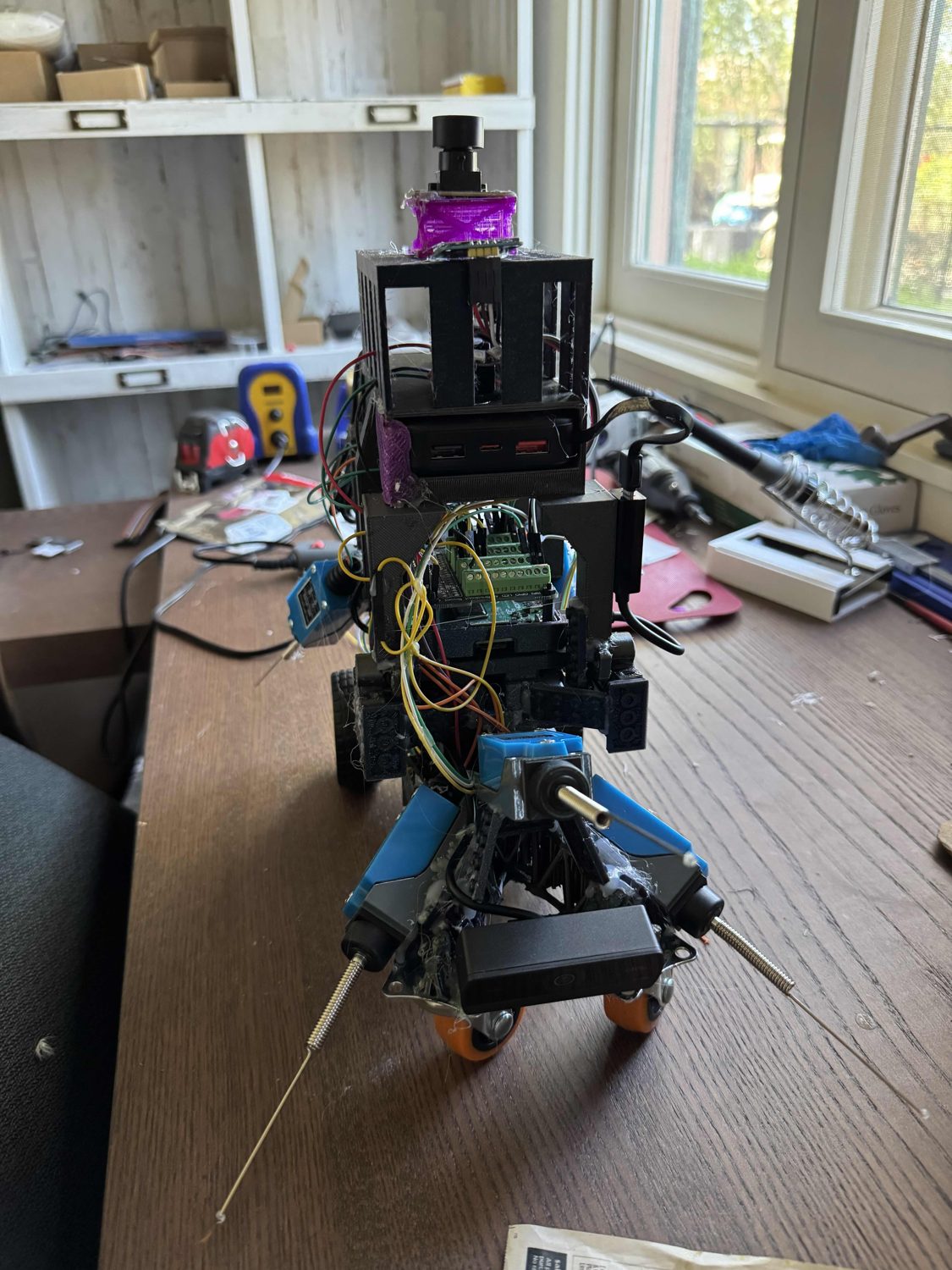
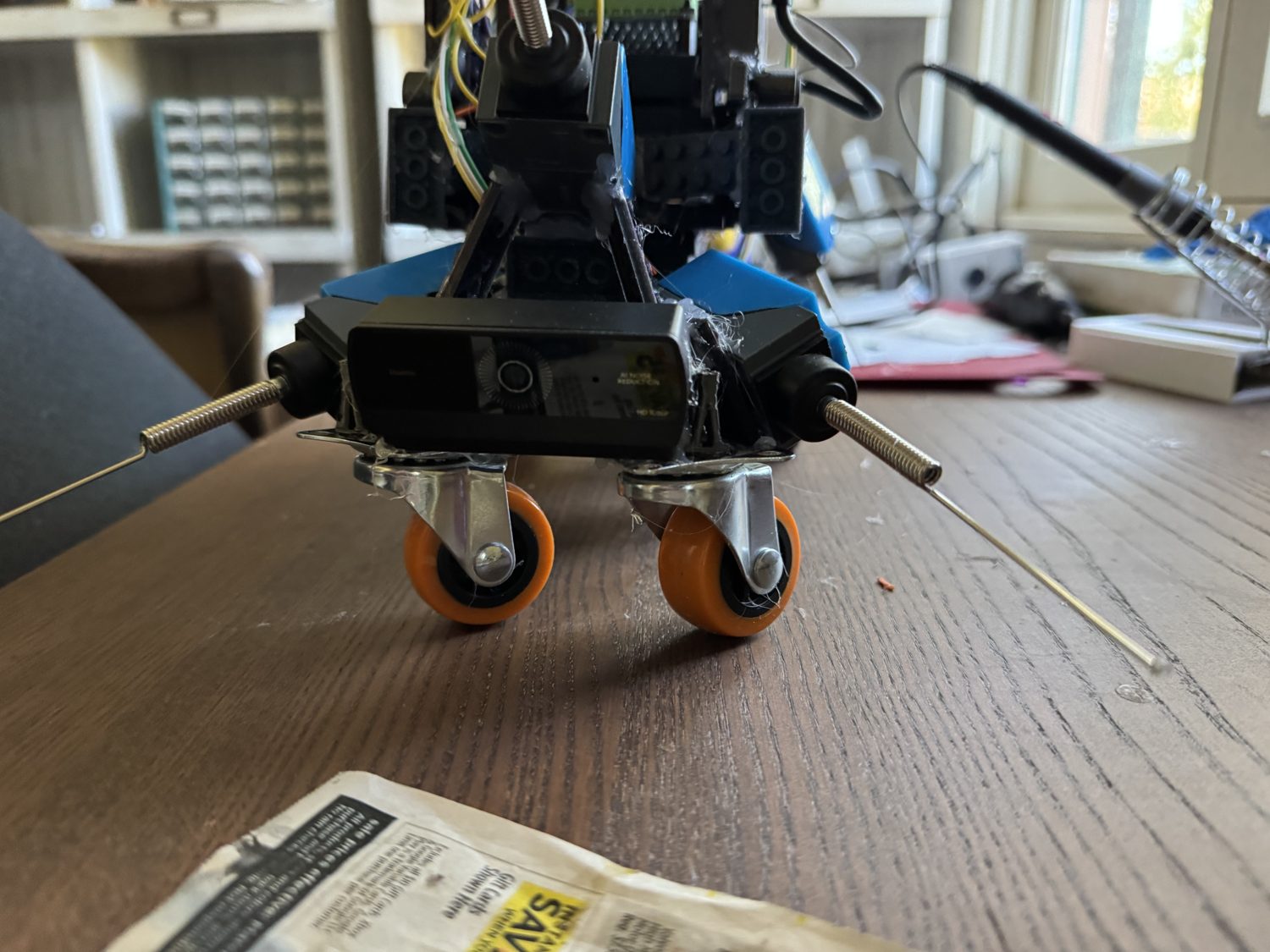
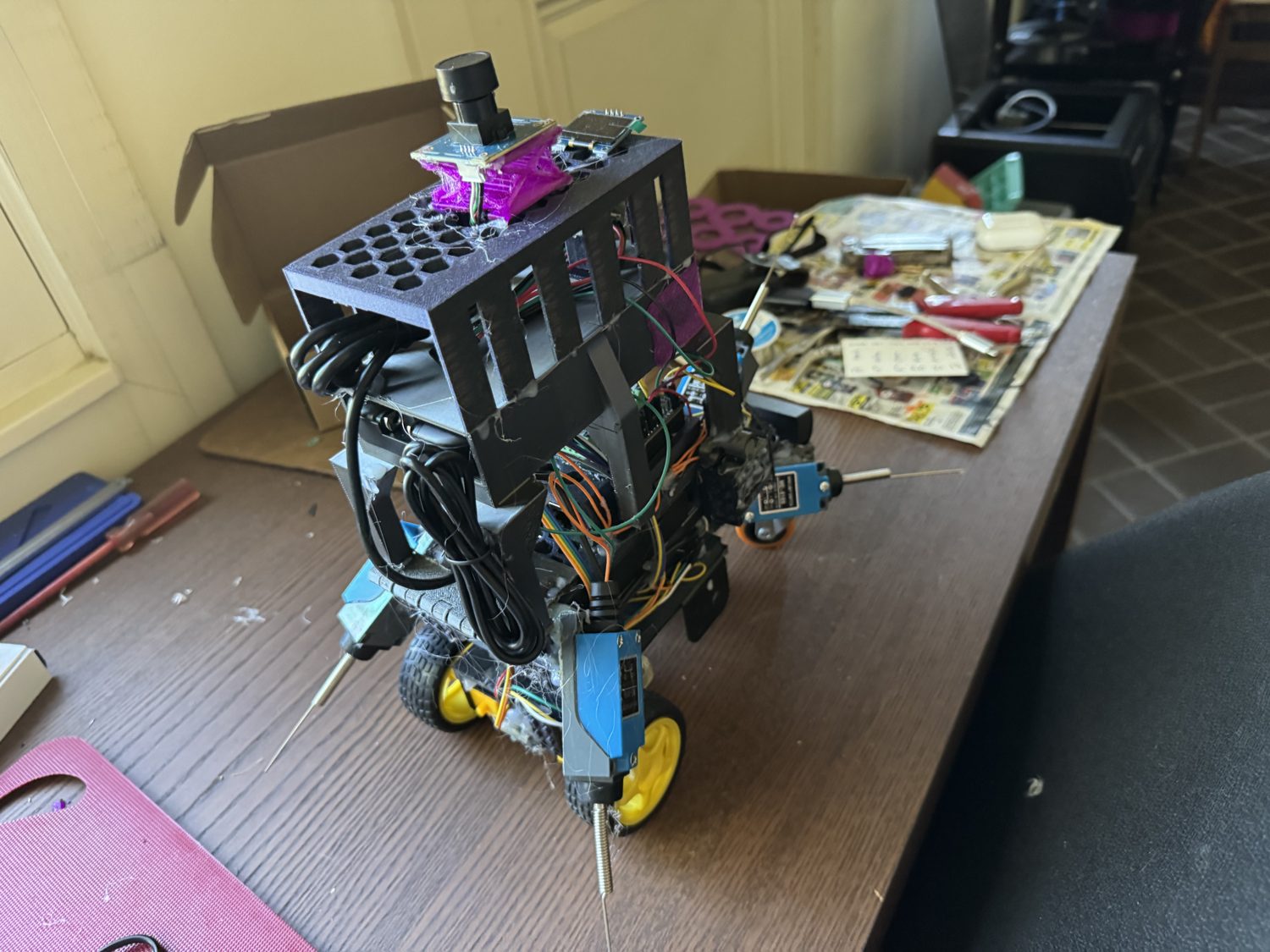
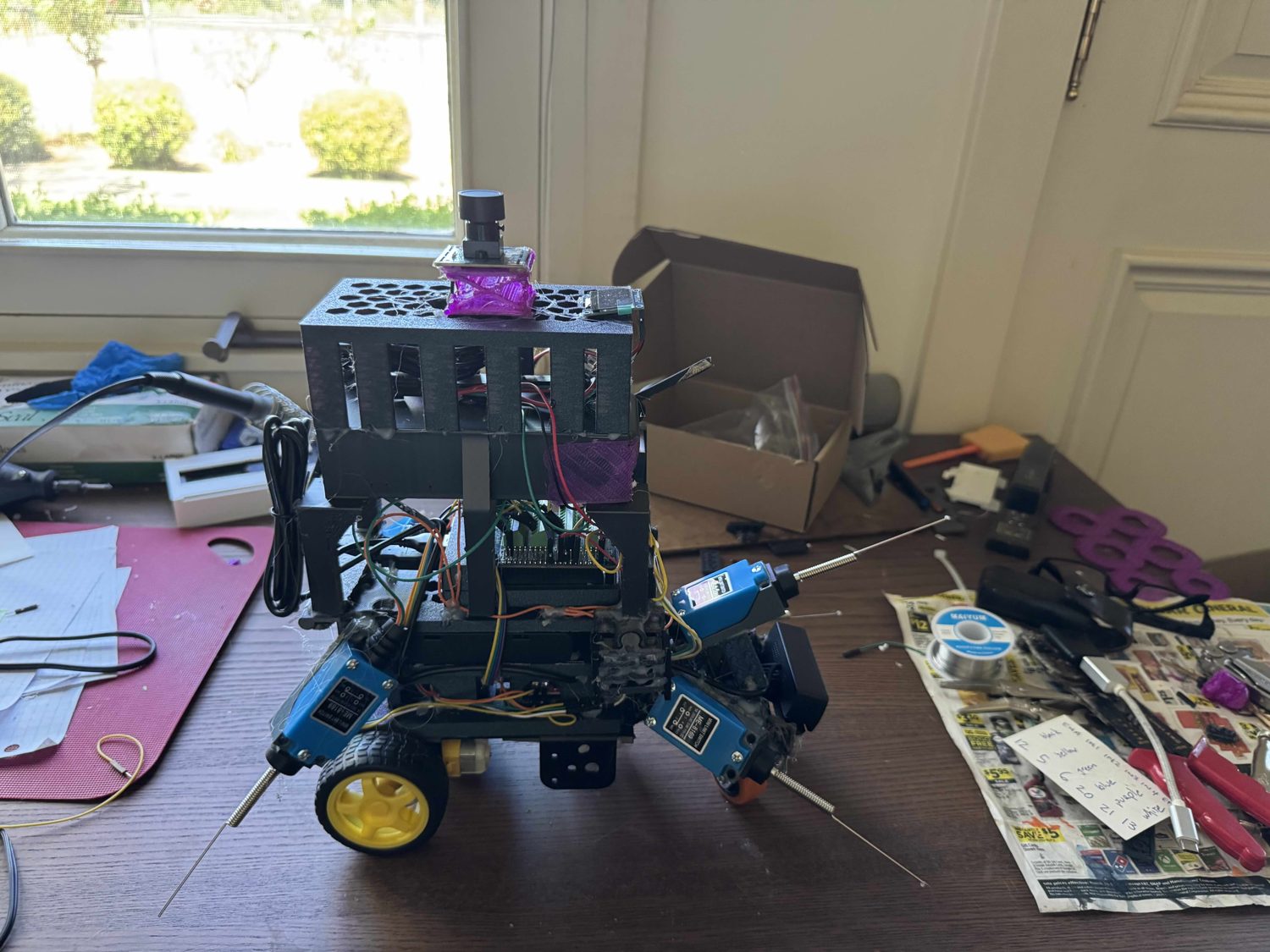
- Turning — fixed. ✅ Four fixed wheels always scrub during a turn, and the little motors couldn't do it on a chassis grown heavy with brain, battery, and face. No software cured it because it was never software. So we rebuilt Remi as a two-wheel differential drive — driven wheels at the back, trailing castors up front, the way every robot vacuum is built — moved one encoder to a driven wheel, and recalibrated. It turns clean now.
- Feeling its own wheels. ✅ The encoders count, and Remi self-calibrates: it drives a varied little pattern and fits the left/right wheel correction that makes the turn its wheels imply match the turn the gyro actually felt — no ruler needed. The body learning its own proportions.
- Whiskers. ✅ Five touch springs ring the body; each bump pulls a pin to ground. A bump is a clean jolt of prediction error from contact — "that wasn't in my plan" — which is the same reafference machinery as the self, now arriving through skin instead of wheels.
- The brain on the metal. ✅ The big one: the same self-model from the simulation now runs on the actual robot, unchanged — it never knew it had been in a sim. Drive it across the floor and a readout shows where it thinks it is, which way it thinks it's pointed, and a surprise meter that spikes when the world and the model part ways.
- A head and an eye. 🖨️ A printed head/shell and a camera truss carrying a downward webcam — Remi is starting to look like someone, and to have something to look at.
- Next. Wire the face to the brain's real state so the inside shows on the outside; build the downward-camera "retina" and the first cross-modal module (wheel↔gyro: "am I turning the way I meant to?"); then run the eating-and-scoring economy (below) — the first test of the whole creature at once.
The whole point of the build is that it is falsifiable in a way a ten-year-old can see — and it is no longer a thought experiment, because that brain now runs on the actual machine. Let Remi drive across the floor, then give it a push, and the surprise meter jumps: the robot registers that the shove wasn't its own doing. Turn the self-model off and it gets lost; turn it on and it stays found and notices the shove. A couple of months ago he was a pile of parts on the floor.
R3M1 — version 1.0, on the bench
What he actually looks like right now: a stack of printed parts, salvage, LEGO, and far too many jumper wires. Nothing here is finished — that's the point.
What's next: an economy of eating and scoring
The next experiment is the first to put the whole architecture to a single end-to-end test — and on purpose it's a little ecology rather than a chore. A downward camera reads the patch of ground just ahead and sorts it into three things: nothing, food, or score. Remi is given two appetites — a light pull toward food, a strong pull toward scoring — and one rule that ties them together: it must fill up on food (a few mouthfuls, with a digestive pause between each) before a score will "count." Eaten patches deplete for a while, so it can't just camp on one spot — it has to remember where the other patches are and come back when they've recovered. Crucially, nothing about the strategy is programmed in. If the architecture is right, the forage-then-score behavior should emerge from those two appetites alone — and whether it does is a real test of memory and prediction, with numbers to keep me honest: points scored, foraging efficiency, how often it wastes a trip to a patch it already ate. (To a behavioral ecologist it's the Marginal Value Theorem; to my son it's "eat your dinner before dessert.")
The eye that does this is itself a scrap of the theory made physical. It isn't a high-resolution camera; it's a coarse grid of colored cells — a cheap retina — angled to see from right in front of the wheels out to the horizon. That one cheap view yields three things at once: what is there (each cell's color), which way to steer (which columns hold the food color), and how close it is (which rows — the bottom of the frame is at its feet, the top is far away). Perception and action are fused right at the sensor: a partial smear of food-color means "approach"; the near rows going solid means "you're on it — eat." That is motility-first in hardware — the form the eye builds already implies the move.
There's a name for what this experiment is really testing. In Stan Klein's evolutionary account (see the theory and bibliography, #443), the Cambrian crossing is from respondent — behavior merely triggered, the Roomba he uses as his own example — to agent: behavior chosen, goal-directed, correctable mid-act, aimed at objects in a world the creature has to project for itself. A Braitenberg vehicle that just drives toward a color is still a respondent. What would make Remi cross the line is exactly the structure here: an internal drive-state that selects the goal (eat when empty, score when full), a memory of patches that aren't currently in view, and a plan that survives interruption. Klein cites Ginsburg & Jablonka's "unlimited associative learning" as the marker of that crossing — which is the published criterion this economy is built to be scored against. So the foraging game isn't a cute demo; it's the smallest test I could design of the respondent→agent transition Klein says sentience was the solution to. (The honest catch from the ledger still stands: emergence of that kind usually needs coaxing, and might not come clean.)
"I didn't try to design a mind and then fill it in. I tried to grow one… The first piece is the one that startled me. Anything that moves has to answer a question constantly: did my situation just change because of me, or because of the world? Solve that one problem — separate your own motion from what's being done to you — and you get a self. Not a soul, not a spark; just the running answer to 'me or not-me.' … So that's the real reason for the letter. Is this anything? Or have I built an elaborate, satisfying thing that only looks like the start of a mind because that's what I was hoping to find? I genuinely can't tell from inside it."
Standing on others' shoulders
I try to be relentlessly reference-conscious, so as not to reinvent what cognitive science and machine learning already know. The closest active-inference framing is Laukkonen, Friston & Chandaria's "A Beautiful Loop" (2025); the robotics precedent is Linson, Clark, Ramamoorthy & Friston (2018); the motor-plus-interoception account of the minimal self draws on Musculus et al. (2021); felt time's body-grounding on Klamut & Weissenberger (2026). The deeper lineage runs through Keijzer's "skin-brain" thesis (nervous systems evolved for moving, not sensing), Godfrey-Smith on the minds of the earliest animals, Damasio on feeling as the body read back to itself, and Cosmides & Tooby on the evolved, modular mind.